
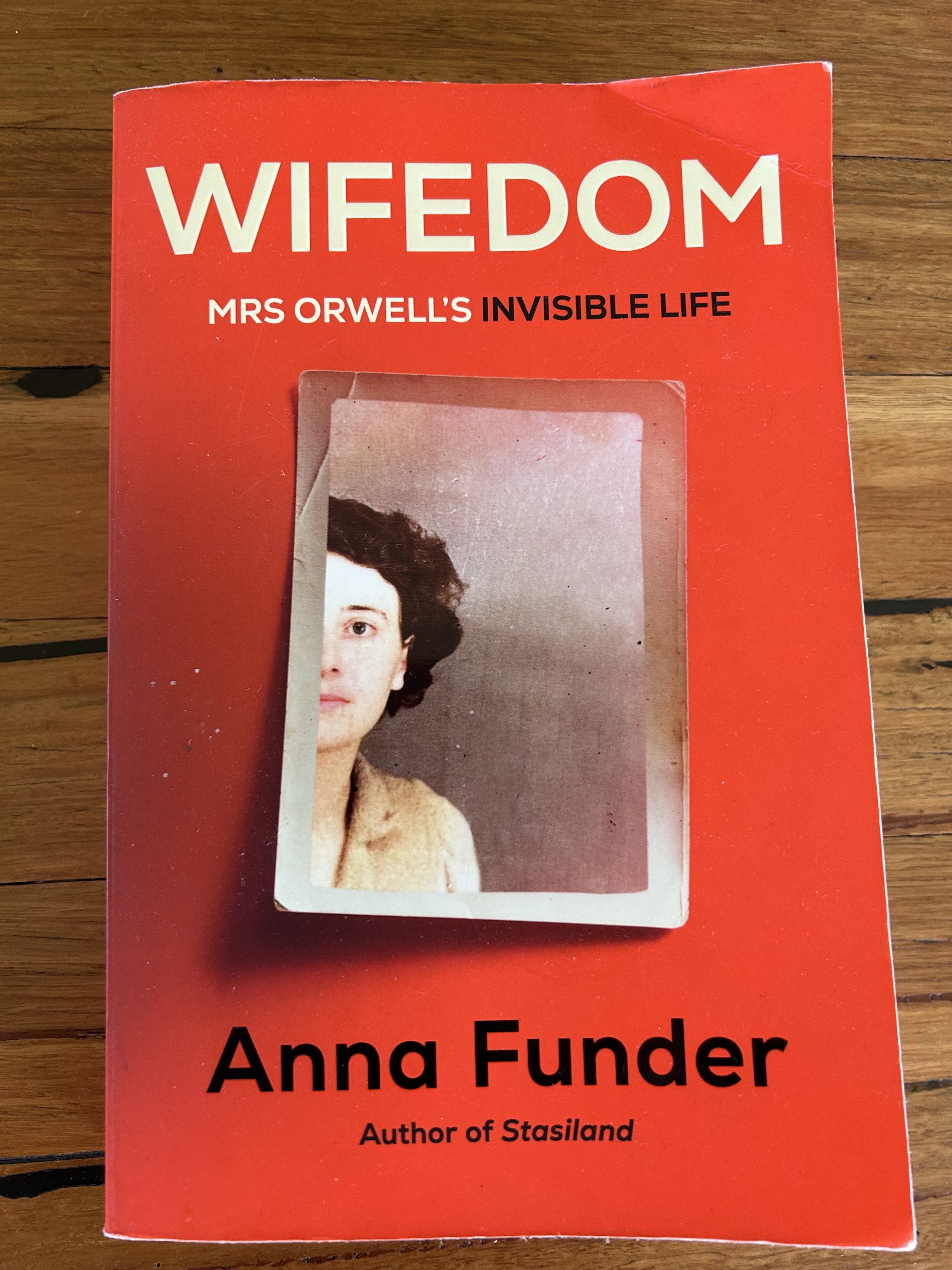
Wifedom (sub-tilted Mrs Orwell’s Invisible Life) by Anna Funder.
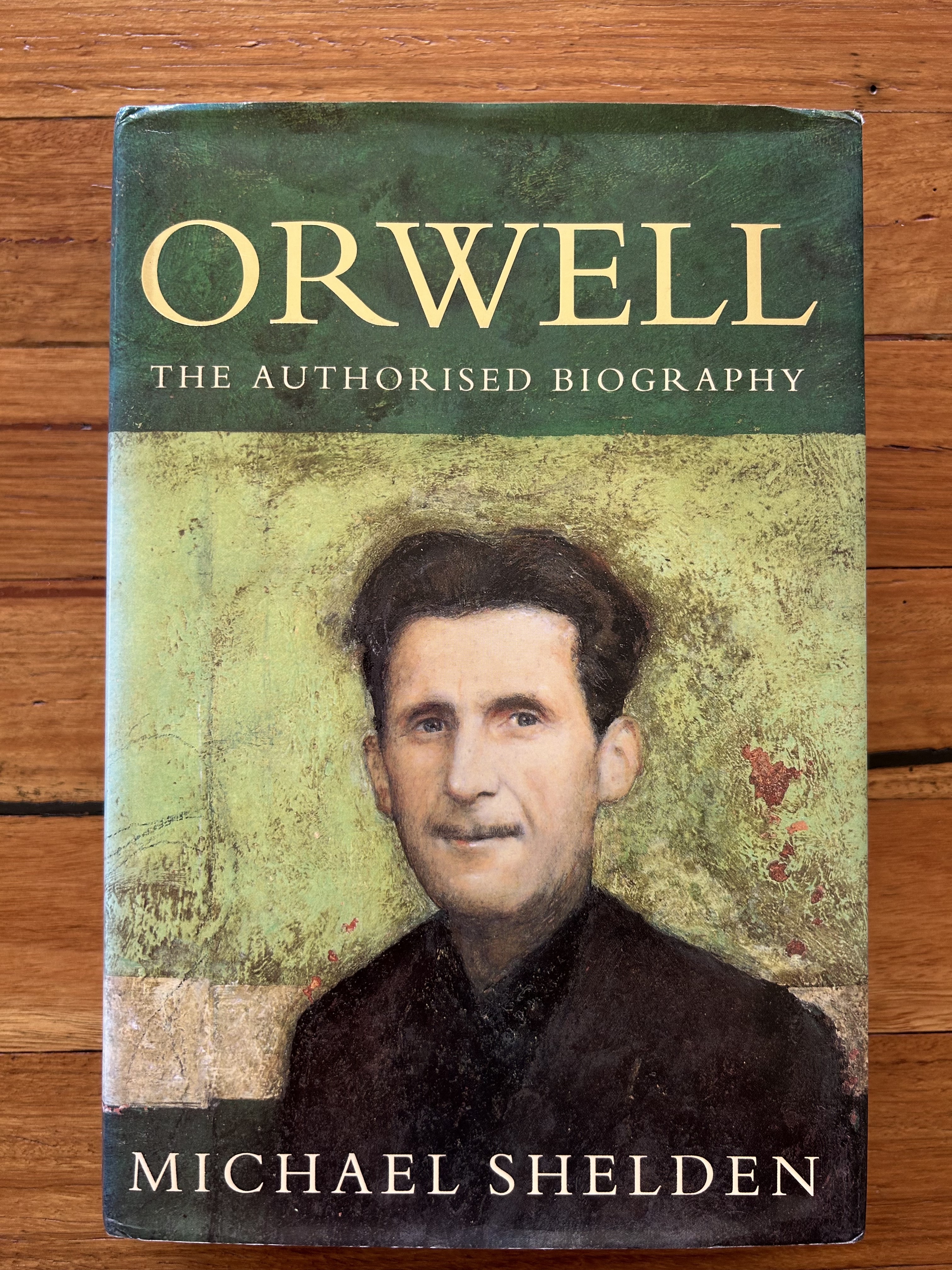
Orwell (The Authorised Biography) by Michael Shelden.
I may have bitten off more than I can chew in this review, but these two books are now joined at the hip for me, forming a new bibliophilic couple, so to speak. Here we go.
The best-selling author of Stasiland, Funder has blended biography and autobiographical memoir in her new book Wifedom, the story of Eileen Blair, first wife of Eric Blair aka George Orwell. I read it first, and then read Shelden’s book, which raised doubts about Funder’s thesis and conclusions.
After querying her own wifedom, Funder set out, as a fan of Orwell’s writing, to read more about the orthodoxies and social tyrannies of his time, as a means to her own liberation. Funder had read his oeuvre, collected essays, journalism and letters, and then added the six major biographies of him (Shelden’s was chronologically number three in 1991).
She then came across what seemed to her evidence of Orwell’s troubling misogynistic attitudes. Apparently this was the trigger for Funder to then spend a few years researching Eileen in all available sources and piecing together this remarkable woman’s life, and her role in facilitating the great man’s career. So, a re-creation from informed guesses, opinions and lots of assumptions.
I’m not convinced that this trigger text clearly implies what Funder makes out. Written in the third person in Orwell’s literary notebook, not his diary, it’s a rant about the incorrigible dirtiness of married women and their insatiable sexual appetite, which leads them to despise their put-upon husband’s subsequent lack of virility. Funder concludes that this was Orwell expressing his own secret thoughts indirectly about his wife, and she delivers a strong feminist denunciation of him. I think that she’s drawn a very long bow.
For starters, Orwell was a blatant womaniser, which Eileen tolerated after their marriage. Perhaps his sex act was somewhat perfunctory, but I’m not sure that equates with misogyny. Moreover Funder demonstrates that throughout his life Orwell was supported by women, and had many close female friends, including for example his aunt in Paris – when he was supposed to be ‘Down and Out’ there, her refuge was close by.
After their marriage, Eileen became the indispensable amanuensis and provider of Orwell’s domestic needs. She curtailed her studies and career ambitions, and supported him with his manuscripts, as a collaborator and editor. Funder claims that the biographers and Orwell himself downplayed, mansplained or ignored her essential role. I don’t intend to become an Orwell scholar by fact checking everything, but my straightforward reading of Shelden does not accord with this view. Throughout his complete biography Eileen is woven into the story and he gives her due recognition and importance – the index lists 45 references for her. After all, it’s a biography of Orwell, not the couple.
Before meeting Eileen, Orwell had completed Down and Out in Paris & London, Burmese Days, The Clergyman’s Daughter, Keep the Aspidistra Flying and Road to Wigan Pier. Undoubtedly she then made very positive contributions to progressing his literary career, which is not to diminish her role but simply to put it in perspective.
Similarly, Funder claims that Eileen’s active participation with the corps of foreigners fighting fascism in Catalonia in 1936 is omitted in Homage to Catalonia, and by his biographers. Based in Barcelona, Eileen handled his logistics and writing output, while bravely involved herself in the dangerous spy games that were swirling around that hotbed of communist and fascist agents. I haven’t yet read Homage, so I accept Funder’s critique that Orwell omitted her deliberately to focus on himself. Shelden definitely covers her involvement in Spain in some detail.
Orwell was an irascible, dependent, grumpy, charming, demanding and complex character, who Funder portrays well in adult life, whereas Shelden’s full biography naturally covers Orwell from before birth to the grave and beyond (in a literary sense).
Funder also inserts her own story and reflections on her wifedom. Like Richard Flanagan in Question 7, this seems to be the new, bold shtick of personal authorial engagement in the narrative’s themes, with elements of memoir. I’m not convinced it works here.
The comparison of Funder’s modern, ‘liberated’ wifedom, as an established author, where she complains of doing more than her fair share of domestic chores, with Eileen’s complete self-sacrifice to Orwell’s needs, doesn’t equate for me either. Qualitatively very different – a comfortable life in the affluent burbs compared to the Blairs often straitened living conditions.
The supporting wife of famous male writers is commonplace, of course. Nabokov’s wife Véra was his typist (he couldn’t type), collaborator and editor, who saved the Lolita manuscript from burning during a low creative period for her Vladimir. James Joyce recruited his sister, another Eileen, to leave Dublin, to join him in Trieste, as minder of his two young children.
If you remember from a previous review, Flanagan’s Question 7 from Chekhov was about whether men love longer than women, which is a blank slate question. And of course normally wives outlive their husbands, but not Eileen and Eric.
A better question is whether women love better than men? Funder’s answer would probably be in the affirmative with the Blairs. Then again, Shelden shows that Orwell had a natural reticence to talk or write about his feelings for his wife, particularly after her death. Eileen was Orwell’s unconventional soulmate, and he didn’t have to write about everything in his heart.
My uncomfortable feeling is that Funder’s emphasis on Eileen’s absence or invisibility may be almost hyperbolic, as it’s surely a matter of degree and judgement about what is fair coverage of the ‘better half’. I got the impression that Funder was fulfilling her feminist objectives, come what may. However, despite my caveats and the irrelevant authorial memoir, Wifedom offers some interesting insights into a literary life and coupledom, and I still enjoyed reading it.
And despite my concentration in this review on Funder’s thesis, Shelden’s complete biography obviously has a wider purview. He gives us a detailed, human, warts-and-all portrait of Orwell, this quirky and most original of twentieth century writers. It’s a captivating read, and if you keep an eye out for Eileen along the way, you won’t be disappointed by her presence.
P.S.
Literary investigation of Orwell the man is apparently fashionable at present, with two new books just out: Burma Sahib by Paul Theroux, about Orwell’s life as a young colonial policeman, which of course inspired his novel Burmese Days; and George Orwell’s Elephant & Other Essays by Subhash Jaireth.
 KOOKYNIE COURIER