
The Federal Opposition finally announced some lightweight details of its risible collective thought bubble about throwing Australia’s power switch to nuclear, and getting rid of those pesky renewables that clog up the grid.
The coalition put together a gang of four of their best political minds to come up with this paradigm-shifting pap for the punters, comprising three Liberal blokes from Queensland and a National from regional NSW. The result is dumbed-down and doesn’t pass any pub test.
Fearless leader Peter Dutton made his revolutionary policy announcement (on Friday 13) just before Xmas, when Australian politicians generally take out political trash so that it gets little attention from pre-occupied shoppers. How does that help sell his policy?
The new nonsense surpasses Tony Abbott’s infamous ‘the science of climate change is absolute crap’, particularly as these energy geniuses refute all the contrary advice of the CSIRO, our distinguished and trusted government science and technology institute.
Seven nuclear plants with 14 large-scale reactors will be built around the country, using government money (as guess what, private capital won’t be interested!), so the gang of four has even jettisoned their supposed core party principles of small government and free markets.
The plants will cost squillions to build with the usual over-runs; probably won’t get finished for decades if at all; way too late for our over-heating Earth; produce electricity prices 50% higher than renewables; and best of all, their modelling is based on electricity demand falling by 30% in decades to come.
I’ll leave you to sort all that political rubbish, as my main mission here is to raise the unmentioned question of nuclear WASTE management, which seems to be absent from the master Dutton plan, and hardly discussed in mainstream media.
Dutton wrongly claimed that a modular reactor would only produce a coke can of radioactive waste per year, when in fact it would produce 27,000 coke cans. Problem is those small reactors are just getting off the drawing board.
A real-life 1GW plant produces 30 tonnes of spent fuel waste or 10 cubic metres per year. So the planned total 14 GW would produce 140 cu.m or 880 barrels annually.
Let’s take a peek at overseas experiences of nuclear waste. Germany closed its last three reactors in 2023, with 303,000 cu.m low & intermediate level waste (LILW) stored in 30 ‘interim’ locations around the country. The life of these materials can be tens of thousands of years.
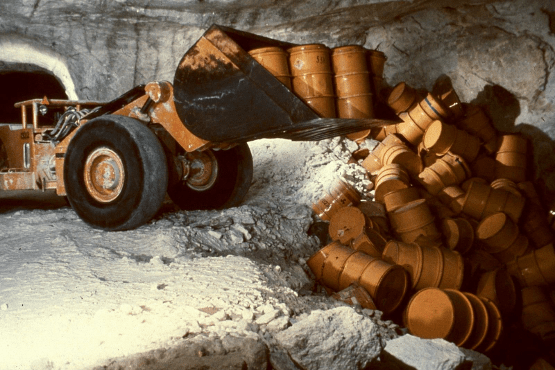
In the 1960-70s LILW went down the old Asse 2 salt mine in Lower Saxony. Drums were carelessly dumped (see photo) and damaged barrels ignored as the rocks would ‘protect’ them. Removal was not planned. Without irony the official website says they would not be eligible for an operating license today. Groundwater flowing through the flooded mines may be contaminated and the stockpile is now 200,000 cu.m. Problem is those rock formations are inherently unstable, so 126,000 waste drums are unsafe and must be removed – planned for 2033, but no location has been chosen.
Nearby Schact Konrad nuclear repository for LILW is under construction in an old iron ore mine, which might begin dumping in 2027 and take 40 years to complete. Adding contaminated materials from decommissioned plants around Germany means there will be 620,000 cu.m to bury. Getting an operating license involves very fraught politics.
High level waste (HLW) from spent nuclear fuel is a whole other can of toxic nuclear worms, which will be radioactive for millions of years. Since 2013 German government agencies have been investigating possible final repository sites for the 27,000 cu.m stockpiles, and hope to finalise the choice by 2046 if all goes well. Meantime they send some HLW to France for processing (and return).
France has re-processed over 36,000 tonnes of spent fuel rods at La Hague in Normandy, but there are 1.8 million cu.m of nuclear waste in the country, of which 1.0 million is LILW. Plans for a repository in eastern France are ongoing, and others in Europe are busy planning too. The USA has 88,000 cu.m of spent fuel and is adding 2,000 more each year, with 77 sites in 35 states, with no re-processing and no repository solution as yet.
Australia produces 40 cu.m (3 truck loads) of LLW and 5 cu.m of ILW per year, and has 17,000 cu.m of LILW stored in drums at the Lucas Heights nuclear medicine facility on the outskirts of Sydney.
A proposal for a nuclear dump at Muckaty Station on the edge of the Tanami Desert north of Tenant Creek, where coincidentally my sister’s partner was running cattle on traditional land, could not get approvals. Ditto with a recent proposal near Kimba in South Australia.
So folks, where are we going to dump our LILW in the Wide Brown Land? Well, the astonishing news is that part of the answer is just down the road from Kookynie in our almost backyard, 177 kms south-west as the crow flies.
Private company Tellus Holdings operates The Sandy Ridge Facility (240 kms N.W. of Kalgoorlie) as a repository for hazardous materials. Using a kaolin open cut mine site, it quietly opened in January 2023, and has 100,000 tonnes of chemical and nuclear LLW stocked in pits with air dome covers. At the end of its 25 year licence, it reverts to Federal government ownership with financial assurances for a further 100 years of monitoring.
I dunno what happens after that, but Kookynie Lo-Tech University (KLOTU) engineers reckon you could cost-effectively replace those domes with tarpaulins later on.
So, ‘problem sorted’ for our LLW, thanks to Australia’s unique comparative advantage of remote, geologically and seismically stable land, with low rainfall and no groundwater in the area. Tellus have offered to take all the country’s suitable LLW. Why isn’t Dutton talking about this?
Perhaps he doesn’t want to talk about ILW and the highly and infinitely toxic HLW? Will we continue sending it to France or the UK for processing and return, and add waste from those seven new reactors? The costs of infinite waste storage don’t appear to be be included in Dutton’s plan, nor the cost of construction of safe repositories and the total waste supply chain
Maybe Queenslanders in the gang of four could ask their major political party donor Gina to sponsor an unused mine out west somewhere in that sunny state, and we can simply roll drums and other contaminated stuff into the mine holes like the Germans did in the 1970s at Arse Too.
And folks, that’s not all, we also have the longer term problem of nuclear plant decommissioning at the end of their operational lives, say 50-80 years from now, estimated at $125 billion in today’s money for the 14 planned reactors. Apparently the UK’s old plants are handed back to the government for decommissioning, so once again thank you taxpayers.
Finally, we also have the question of public liability for disasters, which in Fukushima’s case has amounted to $290 billion for the clean up. No worries, says the World Nuclear Association, as we’ve only had two major accidents (including Chernobyl) in six decades of the industry’s operations across 36 countries. As of May 2023 there were 436 nuclear plants operating in the world, so another back-of-envelope calculation using those two disasters as a guide, puts the failure rate at 0.46%. That’s reassuring.

 KOOKYNIE COURIER
Dear POH, I always read your musings with interest, without necessarily feeling moved to respond with written comment. However, on this occasion, I feel congratulations are in order for pulling together much needed info that should be canvassed in the current nuclear power debate (such as it is). You and your team of Kookynie Lo-Tech University (KLOTU) engineers have done a splendid job! I was reminded of the thoughtful and provocative opinion pieces that appear in John Menadue’s ‘Pearls and Irritations’ – worth a look, if you’re not already a (free) subscriber: https://johnmenadue.us14.list-manage.com/subscribe?u=8074bf8ebb1d809ea8da4b14a&id=0c6b037ecb
Best wishes, Dick
Thanks Dick, much appreciate your support and encouragement.
Actually I was a contributor once to Pearls and Irritations with a memoir piece (that also appeared in KC):
https://johnmenadue.com/peter-ohara-my-lunch-with-french-secret-service-agents-who-sank-rainbow-warrior/
Oh, yes. I remember reading the P&I piece at the time. Enjoyed re-reading it again now.
Love it, gifted ❤️