
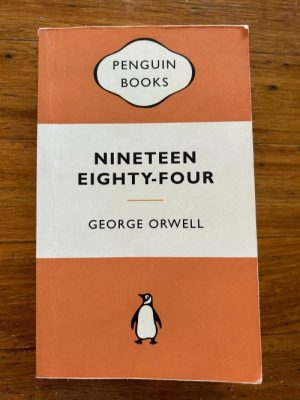
George Orwell’s ‘1984’ as shorthand to signify totalitarian control of society and the malign pervasive rule of ‘Big Brother’ have become timeless all-purpose tropes, with ‘Orwellian’ completing the trifecta. I’m not sure we’ve all read the book (or as often stated ‘ages ago’), so let’s have a fresh look and see how it’s travelling seventy-seven years later.
The genre is called dystopian (science) fiction or political fiction or similar, but as the story is set thirty-five years into the future, as imagined in 1949, clearly Orwell was warning us about what may happen then, a possible scenario.
Orwell lived through an intense political period in Europe, with fascist governments in Germany, Russia and even Spain, which gave him plenty of raw material and inspiration for his imaginative writing about socialist and totalitarian regimes.
He created a world divided into three states constantly at war with each other. The action takes place in London (known as Airstrip One) in the state of Oceania, which bizarrely consists of The Americas, British Isles, Australasia and Southern Africa. Oceania aims to become undisputed master of the entire world by gradually acquiring more territory or discovering unanswerable new weapons.
The Party rules absolutely with English Socialist (or IngSoc in Newspeak) policies, so private property is abolished and all state assets are administered by the Inner Party members, with assistance from the Outer Party and the Proles making up the submerged masses.
A foundational aim is to keep material comfort very modest for all, even for Inner Party members. Production must be maintained without increasing the real wealth of the world, and not distributed to the masses above subsistence level requirements, so that constant warfare is required to soak it up. The masses must not get too intelligent and language is constantly reduced and revised to literally dumb people down.
Our hero Winston Smith works in the Ministry of Truth, ironically charged with controlling official facts and history. His job is to alter public records and integrate new Doublethink ideas. His girlfriend Julia works in the Fiction Department of the Ministry, which has a Pornosec group producing Spanking Stories and other porn for the masses.
‘Telescreens’ are compulsorily on in every habitation, both broadcasting state material and with cameras surveilling the citizens, monitored by Thought Police for any deviance from approved behaviour. Official slogans abound: War is Peace, Freedom is Slavery, Ignorance is Strength or v.v. The Party aims to extinguish independent thought using these manipulative methods. along with other Ministries of Plenty (actually rationing), Peace (War) and Love (Law & Order, suppression of dissidents).
The image of Big Brother, supreme deified leader, who is undoubtedly modelled on Stalin, is broadcast constantly on telescreens. A supposed resistance group known as the Brotherhood appears to challenge the party order, but I’ll let you (re)discover what happens there, and how the Winston & Julia love story unfolds.
With the scene set, I’ll now venture a short critique of how the book’s main ideas and themes have worked out in this post- 1984 world.
Firstly, an obvious and glaring miscalculation by Orwell is the idea of socialism prevailing in the Western world, with nationalisation of all property and total control of the ‘means of production’. As mentioned earlier, in that pre-post war period totalitarian socialism and revolution were indeed on the march in Europe and elsewhere, so that misapprehension is understandable.
Orwell was an astute observer of society and institutions, but he apparently under-estimated the universal and tenacious allure of private property and the organic resilience of modern capitalism. The idea of socialist overlords restricting human consumption to subsistence levels also bizarrely ignores our endless human appetites for goods and services. And the power of the unstoppable new industrial age of efficient machines producing a veritable cornucopia of cheap stuff, generated by profit-driven capitalists, which had been playing out since the Industrial Revolution.
‘Socialist republics’ have nearly all succumbed to individualistic free enterprise in some shape or form, for example overlaid with central planning in the case of China and oligarchical kleptocracy in the case of Russia.
Secondly, Orwell foresaw the ubiquity of telescreens everywhere, as a means of mass control and surveillance, but without an idea of the internet he imagined a closed, centralised system. Nowadays portable telescreens are voluntarily carried around by each of us. We freely give away personal information and innermost thoughts to digital platforms, which generate massive profits from our data.
Not Big Brother but the all-powerful oligopoly of Big Tech, since the internet has done the exact opposite to 1984 and unleashed decentralised, global communication systems that science fiction writers could not have imagined. As always in a capitalist world, big companies gobble up small players, and oligopolies entrench their market dominance and control. Yanis Varoufakis coined the term techno-feudalism, and yes we are the serfs, so there is in fact an equivalence from book to reality taking shape.
Our ‘telescreens’ and social media are of course changing rapidly, and some totalitarian regimes are working hard to control and successfully censor their national networks. Democratic governments are even complicit or negligent in these censorship efforts, as Maria Ressa (Nobel Peace Prize winner) warns: “The greatest threat we face today isn’t any individual leader or one government. It’s the technology that’s amplifying authoritarian tactics worldwide, enabled by democratic governments that abdicated their responsibility to protect the public … tech platforms have become weapons of mass destruction to democracy.”
So the general thrust of Orwell’s portrayal of totalitarian control methods still rings true, albeit occurring very differently from his scenario. Cory Doctorow identified the rapid ‘enshittification’ of the internet as drastically reinforcing oligarchical control. How the incredibly rapid introduction of AI will effect our government, military and social systems is anybody’s guess, and we wouldn’t expect Orwell to have had an inkling of that technological development.
Thirdly, rather than narrowing and tightly controlling language use through Doublethink and Newspeak methods, our world is full of language extensions, inventions and irrepressible linguistic expression. It’s also awash with disinformation, misinformation, conspiracy theories and tropes, but all in an open environment of free range and diverse voices.
Finally, the book is a dour read, somewhat over-done for my tastes, certainly not uplifting, but still a salutary tale for our era of creeping totalitarian threats. World wide sales have topped 30 million, and spike with gross incidents of government surveillance or Newspeak. The vibe still works well.
 KOOKYNIE COURIER