
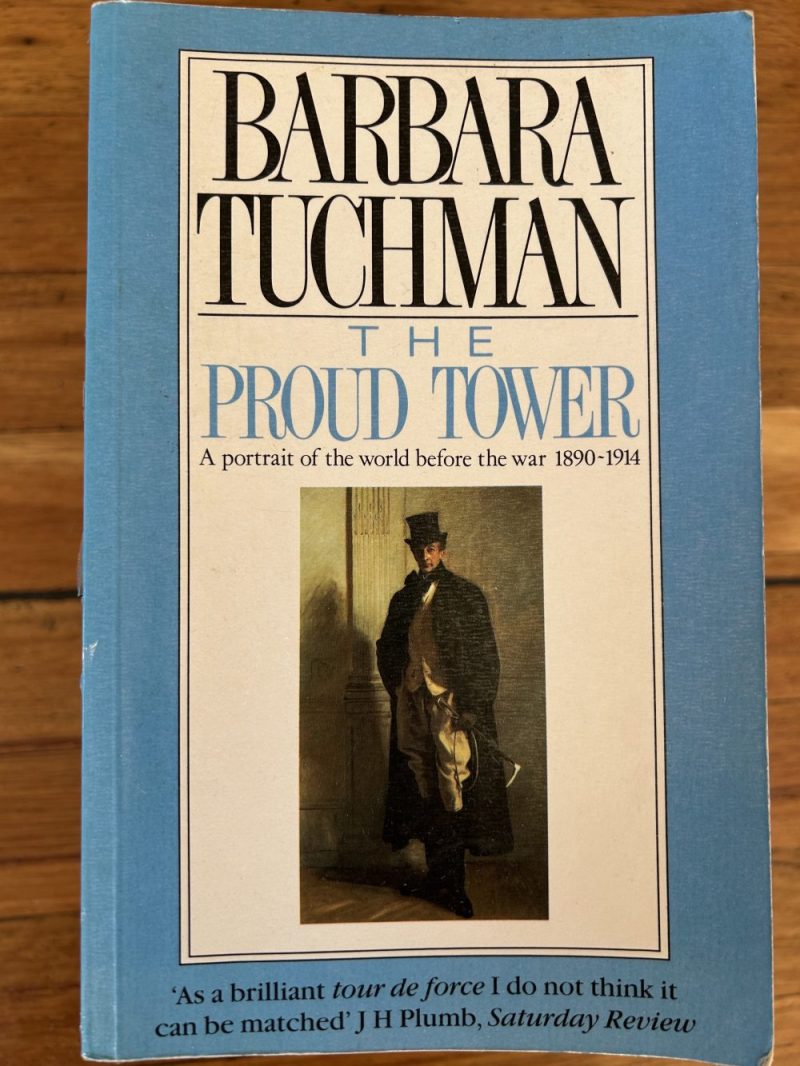
Subtitled A portrait of the world before the war 1890-1914, by Barbara Tuchman, it is an impressive history of the dynamic societal, cultural movements and political forces that built up rapidly with industrialisation in western Europe and the Anglo-American sphere, and that created the irrepressible impulses leading up to the Great War.
Tuchman keeps her historical perspective to what was known at the time, which gives a sense of immediacy. I agree with Michael Foot who says that she has ‘a gift of recreating a period and a mood by an inspired selection of detail and sheer narrative sweep…’
Each country is covered from different perspectives. England is a study of aristocratic, patrician government at the height of British imperialism. Anarchism spreads rapidly across Europe and the USA, with assassinations of six heads of state. Rise of American imperialism told through the life of Thomas B. Reed, Republican Speaker of Congress, a political colossus. The Dreyfus Affair splits French society, and calls for revenge on Germany for past humiliations. Czar Nicholas II calls for international conferences on armaments limitations, as does Alfred Nobel, explosives manufacturer. Three Peace Conferences are held, and meantime the Great Powers are furiously re-arming. German unification and militarism are stoked with Richard Strauss’s music, Nietzsche and other atavistic cultural influences. New socialist politics in England, France and Germany fail to dampen the beating war drums.
Pundits are now suggesting that the history of this critical pre-WW1 period is instructive in helping to understand current, tumultuous world events, and to avoid history repeating itself. A book cover review of The Proud Tower* says that as a brilliant tour de force it cannot be matched. That’s probably hyperbolic, as the book was written in 1966, but nevertheless I highly recommend it.
*”While from a proud tower in the town, Death looks gigantically down”
– Edgar Allan Poe (‘The City in the Sky’)
 KOOKYNIE COURIER